

How Much Does a Paver Patio Cost in Utah? 2026 Price Guide
Last updated: July 2026. We review and update this page annually as material and labor costs change.
Most people arriving here want one number — a figure to hold up against the vague idea in their head and decide whether to keep going or let it drop.
Fair enough. Here it is up front, and then we’ll do something more useful with the rest of this page.
In 2026, a professionally installed paver patio in Utah generally runs $18 to $32 per square foot. For a typical 400-square-foot patio, that’s roughly $7,200 to $12,800.
That’s a wide range, and the width is the actual story. Two bids on the same backyard can land $6,000 apart while describing what sounds like the same patio. Understanding why is worth more than the average, because it’s the difference between choosing the right bid and choosing the cheap one.
On This Page
- What Utah homeowners are paying in 2026
- Why the online calculators lowball Utah
- Where the money actually goes
- What moves your number up or down
- When a bid comes in way under
- What the add-ons cost
- Is doing it yourself cheaper?
- How to get a real number for your yard
- Frequently asked questions
What Utah Homeowners Are Paying in 2026
Here’s the range by project size, assuming standard concrete pavers and a straightforward site:
| Patio size | Typical installed cost |
|---|---|
| 200 sq ft (roughly 14′ × 14′) | $3,600 – $6,400 |
| 400 sq ft (roughly 20′ × 20′) | $7,200 – $12,800 |
| 600 sq ft (roughly 20′ × 30′) | $10,800 – $19,200 |
Premium materials move the top of that range. Natural stone, travertine, and porcelain typically add $8 to $20 per square foot over standard concrete pavers, so a 400-square-foot patio in natural stone can reach the high teens or low twenties in thousands.
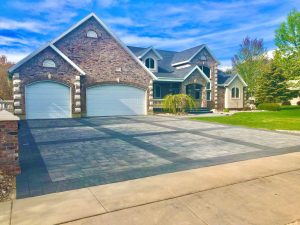
Driveways price differently and generally cost more per square foot than patios, because the base underneath has to be roughly twice as deep to carry vehicle loads.
These are 2026 market ranges for planning purposes, compiled from published Utah and national cost data and reviewed against what we see on real projects. They are not a quote — the variables below are what move your actual number.
Why the Online Calculators Lowball Utah
If you’ve already searched this, you’ve probably seen national figures of $8 to $25 per square foot and wondered why Utah quotes come in higher.
It’s not markup. It’s the ground.
National averages are built on a national mix of soil and climate, much of which is well-drained and mild. Utah is neither. We have heavy clay soils across much of the Wasatch Front and a freeze-thaw cycle that runs on and off all winter, and both of those get solved in the same place: the base under the patio.
Industry minimums call for about 4 inches of compacted base under a pedestrian patio. In Utah we build 6 to 8 inches, and 10 to 12 under a driveway. That’s not gold-plating — it’s what keeps a patio flat through fifteen Utah winters instead of five. But it means significantly more excavation, more hauling, more material, and more compaction time than the same patio would need in Sacramento.
A national calculator doesn’t know that. Your bids do.
Where the Money Actually Goes
Here’s the part almost nobody explains, and it reframes the whole conversation.
The pavers are the smallest part of your bill.
On a typical Utah patio, the stone itself accounts for roughly a quarter to a third of the total. Labor runs about half to sixty percent. The remainder is base material, hauling, disposal, sand, and edge restraint.
Put concretely, on that 400-square-foot patio:
- Excavation and disposal. Going down 9 to 11 inches produces around 12 cubic yards of spoil. That’s a machine, an operator, and either a dumpster or repeated trailer runs to a dump site — before a single paver is touched.
- Base material. That same patio swallows roughly 13 tons of road base at a 6-inch depth. Delivered, spread, and compacted in 3-to-4-inch lifts, with multiple passes on each one.
- Bedding sand. An inch, screeded dead flat across the whole surface.
- The pavers. Materials typically run $4 to $10 per square foot for concrete pavers.
- Cutting. Every perimeter piece, every curve, every transition — wet-saw work, and the more your design curves, the more of it there is.
- Edge restraint and joint sand. The least visible line item on the bid and one of the most important, because it’s what stops the field from spreading.
Add it up and the majority of what you pay goes into work that ends up permanently buried, where you will never see it again. That’s uncomfortable to hear when you’re choosing between bids, and it’s exactly why the cheapest bid is usually cheap.
What Moves Your Number Up or Down
Two identical-looking patios can price very differently. These are the variables that do it:
- Backyard access. This is the single most underestimated cost driver. If a machine can reach the work area, excavation and material handling are fast. If everything has to come through a 36-inch gate by wheelbarrow, the same job can take twice the labor hours. Thirteen tons of base moved by hand is a different project.
- Demolition. Removing an existing concrete slab typically adds $3 to $6 per square foot. Old asphalt and old patios both count.
- Site prep and grading. Standard prep runs around $2 to $5 per square foot. Serious grading corrections or drainage work can push that to $8 to $15.
- Pattern complexity. Running bond is fast. Herringbone, basketweave, and circular patterns mean more cuts and more waste — often a 15 to 30 percent premium on the install.
- Shape. Curves cost. Every curve is a row of individually cut pavers.
- Material choice. Standard concrete, premium concrete, porcelain, travertine, and natural stone span a wide price band.
- Where you are in Utah. St. George projects can use somewhat less base than the Wasatch Front. Mountain valleys like Park City, Heber, and Midway sit at the demanding end for both base depth and drainage.
When a Bid Comes In Way Under — What Got Removed
Say the range on your project is $18 to $32 per square foot and a bid arrives at $12.
That money came from somewhere. The pavers cost what they cost, and no contractor is working for free. So the savings almost always come out of the part you can’t inspect once the job is done:
- A shallower base. Four inches instead of eight. Invisible on day one. Very visible in year three.
- Base dumped rather than layered. Compacting 8 inches in one pass only densifies the top few. Everything under it stays loose.
- Sand used to fix grade. Bedding sand should be a uniform inch. When it’s used to smooth over a lumpy base, every one of those dips reappears in the pavers within a couple of seasons.
- No edge restraint. Saves a few hundred dollars and guarantees the perimeter spreads and the joints open.
- Skipped subgrade compaction. The native soil under the base never gets compacted, so the whole assembly settles into it.
A patio built this way looks identical to a properly built one for about eighteen months. Then it starts to move. And the repair isn’t a patch — it means lifting the pavers, removing the failed base, and starting again from the subgrade. You end up paying for the patio twice.
Five questions that separate the bids
You don’t need to become an expert. You need five questions, and the answers will sort your bids quickly:
- How many inches of compacted base are you installing, and in how many lifts?
- How are you compacting the subgrade before base goes in?
- What edge restraint are you using?
- What slope are you building in, and where is the water going?
- Is the base depth on the written estimate?
That last one matters most. A contractor confident in their base will put the number in writing. Vagueness there tells you what you need to know.
What the Add-Ons Cost
Most people don’t stop at a flat rectangle. Typical 2026 ranges:
- Built-in fire pit: $1,500 – $6,000, depending on size, material, and whether it’s gas-plumbed. (Worth reading first: why most Utah fire pit patios feel awkward.)
- Seat walls: $75 – $150 per linear foot.
- Steps and elevation changes: priced individually; they add both material and significant labor.
- Retaining walls: depends heavily on height and whether engineering is required.
- Low-voltage lighting: usually a modest add if it’s planned before installation and an expensive one if it isn’t.
- Radiant snow melt: a significant investment, and one that has to be designed in before the base goes down — it cannot be retrofitted under an existing patio.
The pattern worth noticing: nearly everything on that list is dramatically cheaper decided before installation than added afterward. Lighting conduit, gas lines, and snow melt tubing all live under the pavers.
Is Doing It Yourself Actually Cheaper?
On materials alone, meaningfully — DIY figures generally land around $12 to $17 per square foot versus $20 to $27 installed.
The honest accounting is narrower than that gap suggests. You’re renting a plate compactor and a wet saw, likely a sod cutter, possibly a jackhammer and a small machine. You’re arranging delivery of several tons of base material and disposal of a dozen cubic yards of spoil. And you’re spending two to four full weekends on it.
Then there’s the asymmetry: if the base fails, the fix isn’t a repair. It’s the whole patio, pulled up and rebuilt from the dirt.
DIY makes real sense on small, flat, low-traffic areas with good drainage — a landing, a short walkway, a grill pad. It gets risky fast on large surfaces, anything on a slope, anything carrying a vehicle, and anything up against the house where drainage mistakes get expensive.
How to Get a Real Number for Your Yard
Everything above is planning context. It is not a quote, and any contractor who gives you a firm price without seeing your yard is guessing at the two variables that matter most: what’s under your soil and how equipment gets to the work area.
A proper site visit settles those. It also tends to change the design — once you’re standing in the space talking about where water goes, where the sun lands at 6pm, and how people will actually move through it, the shape usually shifts. That’s a good thing, and it’s much cheaper to happen now than after excavation.
Strong Rock Pavers has been building patios, driveways, and pool decks across Utah for more than a quarter century — from Provo and Salt Lake City to Draper, Sandy, Park City, Heber, and St. George. We’ll walk your space, talk through what you’re picturing, and give you a real number with the base depth written on it.
Call (435) 703-8937 or request your free design consultation. No charge, and no obligation to book anything.
Frequently Asked Questions
How much does a paver patio cost in Utah?
In 2026, professionally installed paver patios in Utah generally run $18 to $32 per square foot. A 200-square-foot patio typically lands between $3,600 and $6,400, a 400-square-foot patio between $7,200 and $12,800, and a 600-square-foot patio between $10,800 and $19,200. Premium materials like natural stone, travertine, and porcelain push the upper end higher.
Why are Utah paver prices higher than national averages?
National calculators often show $8 to $25 per square foot, based on a mix of climates and soils that are milder than Utah’s. Utah’s heavy clay soils and repeated freeze-thaw cycles require a substantially deeper compacted base — 6 to 8 inches under a patio versus a 4-inch national minimum, and 10 to 12 inches under a driveway. That means more excavation, more hauling, more base material, and more compaction labor on every project.
What percentage of a paver patio’s cost is labor?
Labor typically accounts for about 50 to 60 percent of a paver patio’s total cost. The pavers themselves usually represent only a quarter to a third. The remainder covers base material, excavation and disposal, bedding sand, and edge restraint. That means the majority of the total goes into work that ends up permanently buried beneath the finished surface.
Why is one paver bid so much cheaper than the others?
Because the savings almost always come from the base, which is the one part you cannot inspect after installation. Common shortcuts include installing 4 inches of base instead of 8, dumping base in one lift instead of compacting it in 3-to-4-inch layers, skipping subgrade compaction, using bedding sand to correct an uneven base, and omitting edge restraint. Ask every bidder to put the compacted base depth in writing on the estimate.
Is it cheaper to install a paver patio yourself?
On materials alone, yes — DIY typically runs $12 to $17 per square foot versus $20 to $27 installed. The gap narrows once you add rental of a plate compactor and wet saw, delivery of several tons of base material, disposal of roughly a dozen cubic yards of spoil, and two to four full weekends of labor. If the base fails, the repair means removing the pavers and rebuilding from the subgrade. DIY works best on small, flat, well-drained areas.