

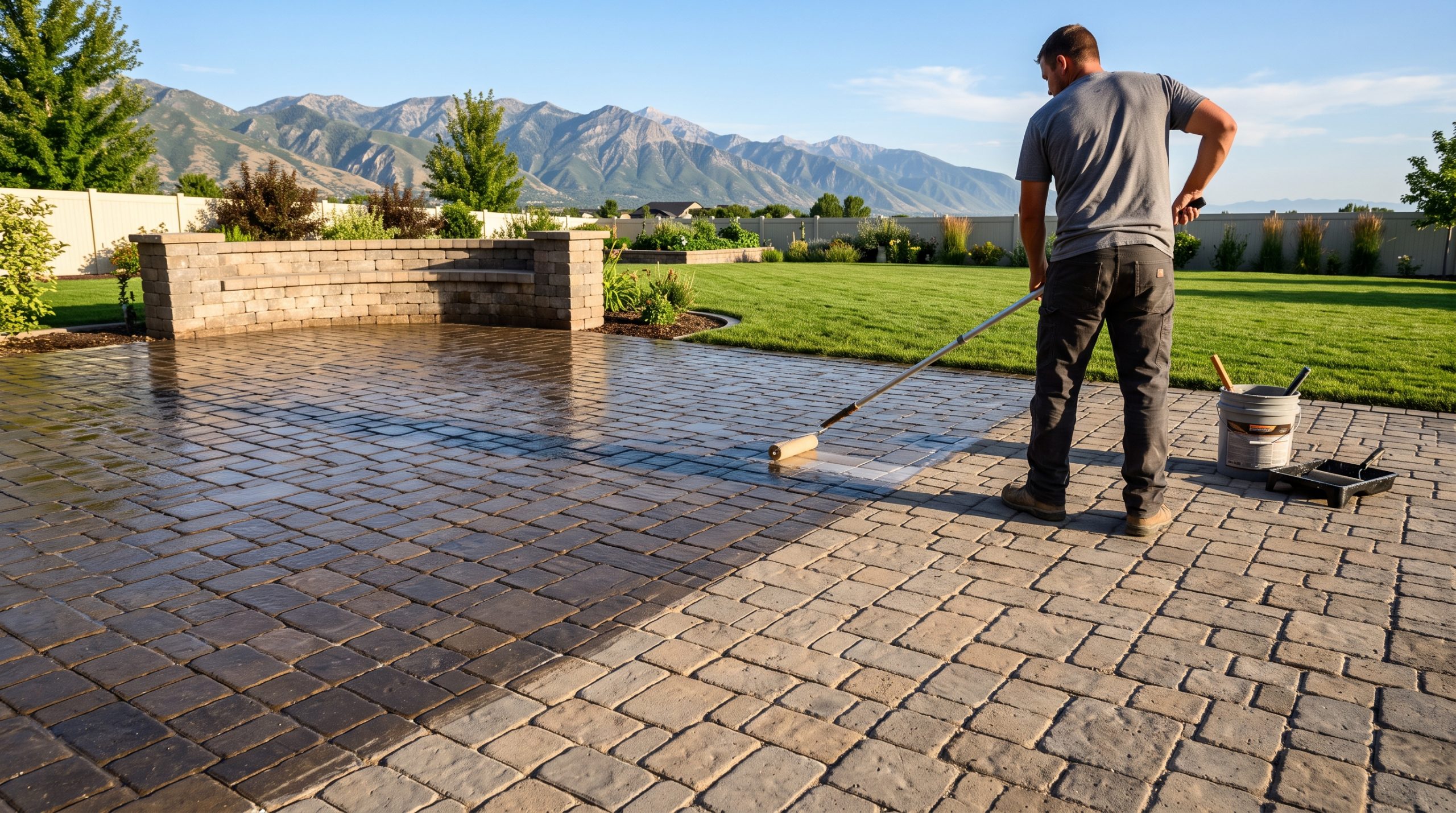
By mid-July, the Utah sun has a way of telling on your hardscape. The patio that looked rich and saturated in April is a shade lighter. There’s a faint white film creeping across the driveway. And some of the joint sand your installer swept in so carefully left with the last sprinkler cycle. So the question comes up every summer: should you seal your pavers — and does it actually matter here in Utah?
Short answer: sealing isn’t mandatory, but in Utah it’s worth it. Quality concrete pavers are engineered to outlast poured concrete with or without sealer. But sealing every 3 to 5 years is one of the lowest-cost ways to protect their color, lock joint sand in place, and make stains and hard-water deposits dramatically easier to remove. The catch is that timing, prep, and product choice matter more here than in most states — get those wrong and sealer can create problems instead of preventing them.
Here’s what 25+ years of installing and maintaining pavers across Utah has taught us.
Why Utah Is Harder on Pavers Than Most States
The paver itself is rarely the weak point. The stones we install are manufactured to withstand more than 4,000 PSI — several times stronger than poured concrete. What Utah attacks is everything around the stone: the pigment on its surface and the sand in its joints.
Four local forces do most of the damage. First, high-elevation UV. The Wasatch Front sits around 4,500 feet, and St. George adds desert-intensity sun on top of that. Ultraviolet exposure slowly bleaches unprotected pigment, which is why an unsealed patio fades noticeably faster here than the same product would at sea level. Second, freeze-thaw cycling. Along the Wasatch Front, moisture in the joints freezes, expands, and thaws over and over every winter, working sand loose and stressing edges. Third, hard water. Utah’s mineral-heavy water means every sprinkler overspray leaves a little calcium behind, building into chalky white deposits on unprotected surfaces. Fourth, washout. Summer monsoon bursts and daily irrigation flush joint sand out of unprotected joints — and empty joints are an open invitation for weeds, ants, and shifting stones.
Sealing doesn’t make your pavers stronger. It defends the two things Utah’s climate goes after: color and joints.
What a Paver Sealer Actually Does (and Doesn’t Do)
A good sealer does four jobs. It deepens and locks in color, with finishes ranging from natural matte to a wet look. It adds stain resistance, so barbecue grease, leaf tannins, rust from patio furniture, and oil drips wipe off instead of soaking in. A joint-stabilizing sealer hardens the sand between stones so sprinklers and storms can’t flush it out. And it makes routine cleaning far easier, because water and grime sit on the surface instead of penetrating it.
Just as important is what sealer won’t do. It won’t fix pavers that have already sunk or shifted — that’s a base problem, not a surface problem. It won’t stop weeds if the joint sand is already gone. And it absolutely will not cure efflorescence, the white mineral haze that naturally migrates out of concrete pavers. Seal over efflorescence and you trap it under a clear coat, turning a temporary cosmetic issue into a cloudy mess that has to be stripped to fix. Prep is everything.
When Is the Best Time to Seal Pavers in Utah?
Late summer through early fall is the ideal window in Utah. By then the monsoon moisture has mostly passed, surfaces stay dry long enough for proper curing, temperatures settle into the comfortable range (roughly 50–85°F is what most sealer manufacturers want), and you’re protected well before the first hard freeze. Spring can work too, but you’re often fighting wet ground, runoff, and unpredictable storms.
Two timing rules matter regardless of season. The surface needs to be fully dry, with no rain or sprinklers for roughly 24–48 hours before and after application. And avoid sealing in direct triple-digit heat — in St. George summer, that means early morning applications — because sealer that flash-dries leaves streaks and lap lines.
One more: don’t seal brand-new pavers right away. Fresh concrete pavers need time for natural efflorescence to migrate out of the stone. Most manufacturers recommend waiting 60 to 90 days after installation before the first sealing. Sealing too early is one of the most common — and most expensive — DIY mistakes we see.
How Often Should You Reseal?
For most Utah homes, every 3 to 5 years keeps pavers protected. Where you land in that range depends on exposure. A south-facing pool deck in St. George or a driveway that catches sprinkler overspray twice a day will need attention sooner than a shaded side walkway in Provo.
There’s a simple test: pour a little water on the surface. If it beads up or the paver darkens slowly, your sealer is still working. If it soaks straight in and the color looks tired, it’s time.
What Happens If You Never Seal Your Pavers?
Honest answer: nothing catastrophic — at first. The stones themselves won’t crumble; that’s the whole point of interlocking concrete pavers. But over the years, an unsealed installation in Utah follows a predictable path. Color fades unevenly, fastest where the sun hits hardest. Stains that would have wiped off a sealed surface set permanently. Joint sand washes out a little more every season, and once the joints are open, weeds and ants move in and edge stones start to loosen and shift.
That’s the point where maintenance quietly becomes repair. The good news is that this is also where pavers show their biggest advantage over poured concrete: individual stones can be lifted, the base re-leveled, and the same pavers reset — no saw cutting, no mismatched patch. Our team handles paver repair across the Wasatch Front and St. George, and honestly, most of the repair calls we get trace back to joints that were left unprotected for a decade.
Sealing is cheap insurance. It’s a big part of why pavers beat poured concrete on 20-year cost: small, occasional upkeep instead of tear-out and replacement.
How Much Does Paver Sealing Cost in Utah?
Professional cleaning and sealing typically runs somewhere between $1 and $3 per square foot, depending on the size of the area, its condition, whether joints need re-sanding, and the sealer you choose. A well-maintained patio on a 3–5 year schedule sits at the low end; a neglected driveway that needs deep cleaning, efflorescence treatment, and full joint restoration lands higher.
For perspective: even at the high end, resealing a patio every few years costs a small fraction of what it takes to demo and repour a cracked concrete slab once. If you want a real number instead of a range, we’ll look at your specific surface and give you a free quote.
Should You Seal Pavers Yourself or Hire a Pro?
DIY sealing is doable on a small, healthy patio — and we’d rather you seal it yourself than not at all. But the failures we get called to fix almost always come from the same four mistakes: sealing over efflorescence or trapped moisture (that’s the white, cloudy haze), using a non-breathable film sealer that can’t handle Utah freeze-thaw, over-applying gloss until it’s blotchy, and skipping the joint re-sand so the sealer has nothing to stabilize.
A professional job is mostly about prep: proper pressure washing, efflorescence cleaner where needed, fresh polymeric or joint sand swept and compacted, and a breathable, freeze-thaw-rated sealer applied in the right conditions. The sealer is the last 20% of the work. The prep is the other 80%.
Signs You Need Repair, Not Just Sealer
Before anyone seals anything, walk your hardscape and look for these: pavers sinking near downspouts or sprinkler heads (base washout), stones rocking or shifting underfoot, edges creeping outward (edge restraint failure), or chipped and cracked units. Sealer locks in whatever state the surface is in — so problems get fixed first, then protected. Because pavers are modular, these repairs are usually surgical: lift the affected stones, correct the base, reset, re-sand, seal.
If you’re not sure which side of the line your patio or driveway is on, that’s exactly what a free assessment is for.
Frequently Asked Questions
How often should you seal pavers in Utah?
Every 3 to 5 years for most homes. High-sun, high-traffic, or sprinkler-heavy areas trend toward 3; shaded, low-traffic areas can stretch to 5. If water no longer beads on the surface, it’s time.
What’s the best time of year to seal pavers in Utah?
Late summer through early fall. Surfaces are dry, temperatures sit in the 50–85°F range sealers prefer, and the finish cures well before the first freeze. You need about 24–48 dry hours before and after application.
Do new pavers need to be sealed right away?
No — wait. New concrete pavers release natural efflorescence for their first few months, and most manufacturers recommend waiting 60 to 90 days after installation before the first seal. Sealing too soon traps the haze under the coating.
What is the white haze on my pavers?
Almost always efflorescence: natural minerals migrating out of the concrete, or hard-water deposits from sprinklers. It’s cosmetic and treatable with the right cleaner — but it must be removed before sealing, never sealed over.
Does sealing stop weeds between pavers?
Sealing alone won’t, but the combination works: fresh polymeric sand in the joints plus a joint-stabilizing sealer hardens the sand so weeds and ants can’t establish. Weeds grow in the joints, not through the pavers — protect the joints and you’ve solved the problem.
Can I pressure-wash my pavers before sealing?
Yes, and you should — carefully. Use a fan tip at an angle, not a direct blast that blows out joint sand or etches the surface. Plan to re-sand the joints after washing and let everything dry completely before sealer goes down.
Ready to Protect Your Pavers Before Winter?
Strong Rock Pavers has spent more than 25 years designing, installing, and maintaining Utah paver installations from the Wasatch Front to St. George — backed by a lifetime warranty on our pavers and a 2-year warranty on workmanship. Whether your hardscape needs a clean-and-seal, a joint refresh, or a repair before sealing even makes sense, we’ll tell you straight which one it is.
Request your free assessment or call us at (435) 703-8937 — the fall sealing window fills up fast.